







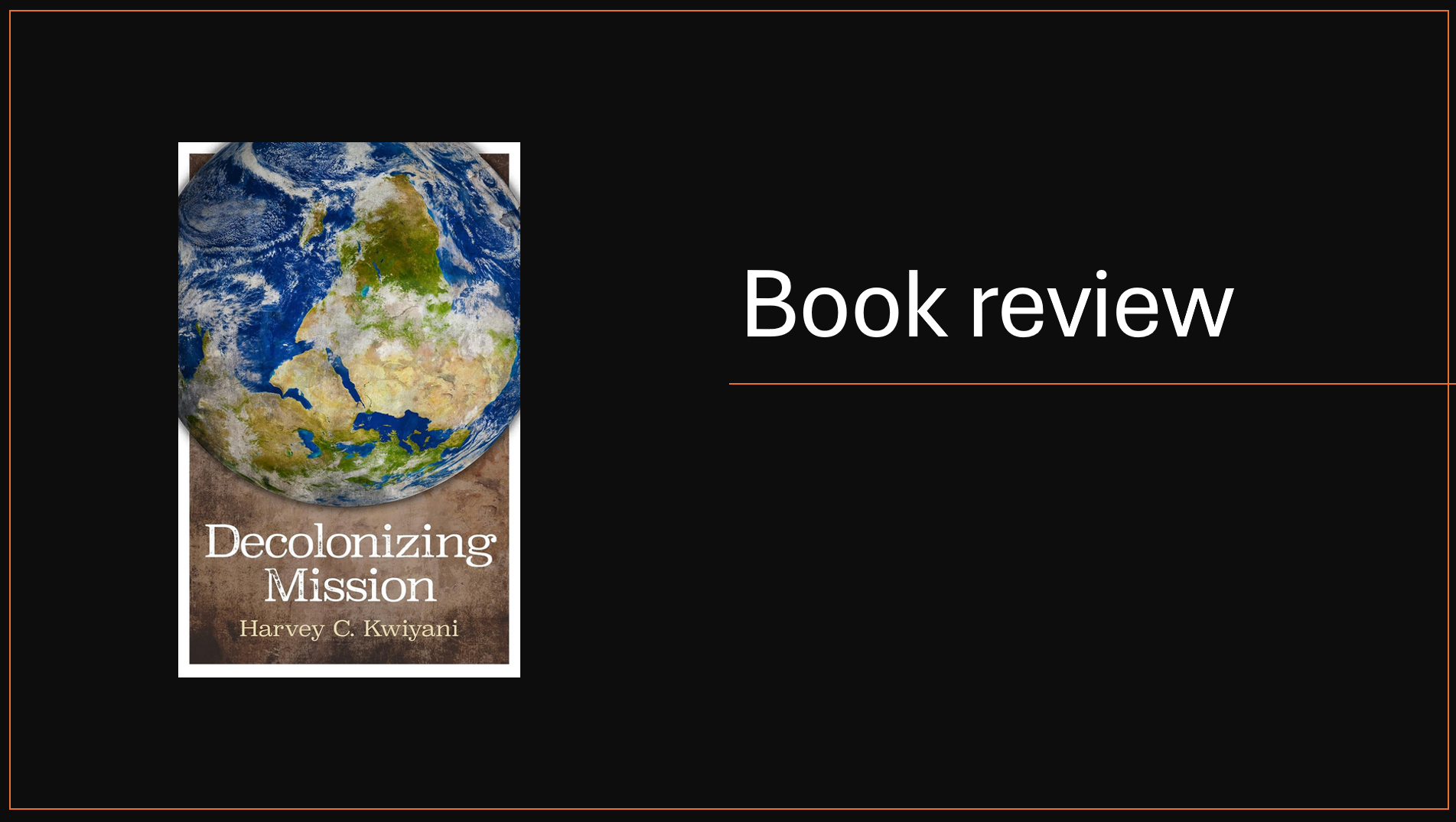

By Marcus Grohmann, Director of the Alliance for Vulnerable Mission, Postdoctoral Researcher at the Beyers Naudé Centre for Public Theology, Stellenbosch University, South Africa.
In this recent publication, UK-based Malawian missiologist Harvey Kwiyani wrestles with the colonial legacy of the concept of Christian mission. Tracing its modern expression back to 16th century Jesuits who were sent “to extend God’s kingdom among the nations”, Kwiyani suggests that up until modern times, “in most cases the earthly expression of that kingdom of God was the European civilization” (loc 2,177). Apart from the inherent white supremacy of this movement, he problematises the violence, which was often associated with forcing peoples into submission, colonising their lands and introducing new forms of monetary economies – all for the alleged benefit of the ‘heathen’. Kwiyani attempts to show how Christian mission did not coincidentally take place at the same time but was inextricably interwoven with the colonial project. An example is Livingstone’s quest for peaceful commerce to replace the big business of slavery in 19th century Africa which seemed impossible at the time without European domination and Christianisation.
After spending significant time on tracing mission’s relationship with conquest and its civilising agenda through the centuries, Kwiyani indicates areas where he sees today’s concept of mission in need of decolonising. These include militant terminology (we ‘recruit’, ‘mobilise’ and ‘deploy’ missionaries), unhealthy African orientation to the West, ongoing Western dominance in global missiology despite the decline of the church in the global North, Western communities only listening to “Western-sounding non-Westerners”, as well as persistent paternalistic attitudes in the West. These manifest e.g. in privileged youngsters going on mission trips to the global South, in a disregard for mission taking place without Westerners involved, or in Westerners’ struggles to evangelise people in their own countries while sending missionaries overseas.
The book can help people see that it is too simplistic to see colonialism as an aberration or a corruption of otherwise sound Christian mission. Coming from locations of power or even empire has shaped much mission thinking in the world. Kwiyani provokes introspection where we – no matter what background – are ourselves part of and perpetuating a colonial system. That said, the author is clearly driven by the conviction that “the sharing of the gospel must continue” (loc 4,433). However, he does insist: “Mission in the twenty-first century must embrace weakness and vulnerability” (loc 4,633).
The possible link to the work of the AVM is obvious. But perhaps, vulnerable mission can play a role in other areas as well, namely in addressing and seeking to resolve some of the tensions that appear in Kwiyani’s book: How do we criticise that “civilizing mission continues” while seeking acknowledgment of authentic non-Western voices in the (formerly self-defined) centres of civilisation? Are there limits to intercultural togetherness in missiology if the West struggles to embrace the otherness of ‘the other’? On what basis is it justified to speak of different ways in which world Christianity is involved in mission if mission continues to be defined through Eurocentric lenses? How can majority world practices of propagating the gospel be acknowledged and understood on their own terms without being ‘swallowed’ or corrected by dominant paradigms of mission?
This personal, uncomfortable and powerful book leaves questions open. It is thus a helpful resource for individuals, groups and mission organisations to grapple with “mission according to the colonized” (loc. 4,130). At the same time, the book brings to light that the need for Westerners to listen to non-Western voices does not make the need for profound cross-cultural learning redundant. On the contrary: Today – as in Jesus’ time – God’s kingdom needs to prove its veracity and subversive power in opposition to structures of empire. This requires costly and embodied discipleship that seeks to practise mission as accompaniment on the linguistic and cultural-religious terms of those different from us. In this process, it would suit Westerners well to remember Kwiyani’s assertion: “we who have come from the formerly colonized lands will often not trust Westerners until we see them vulnerable with us” (loc 278).